
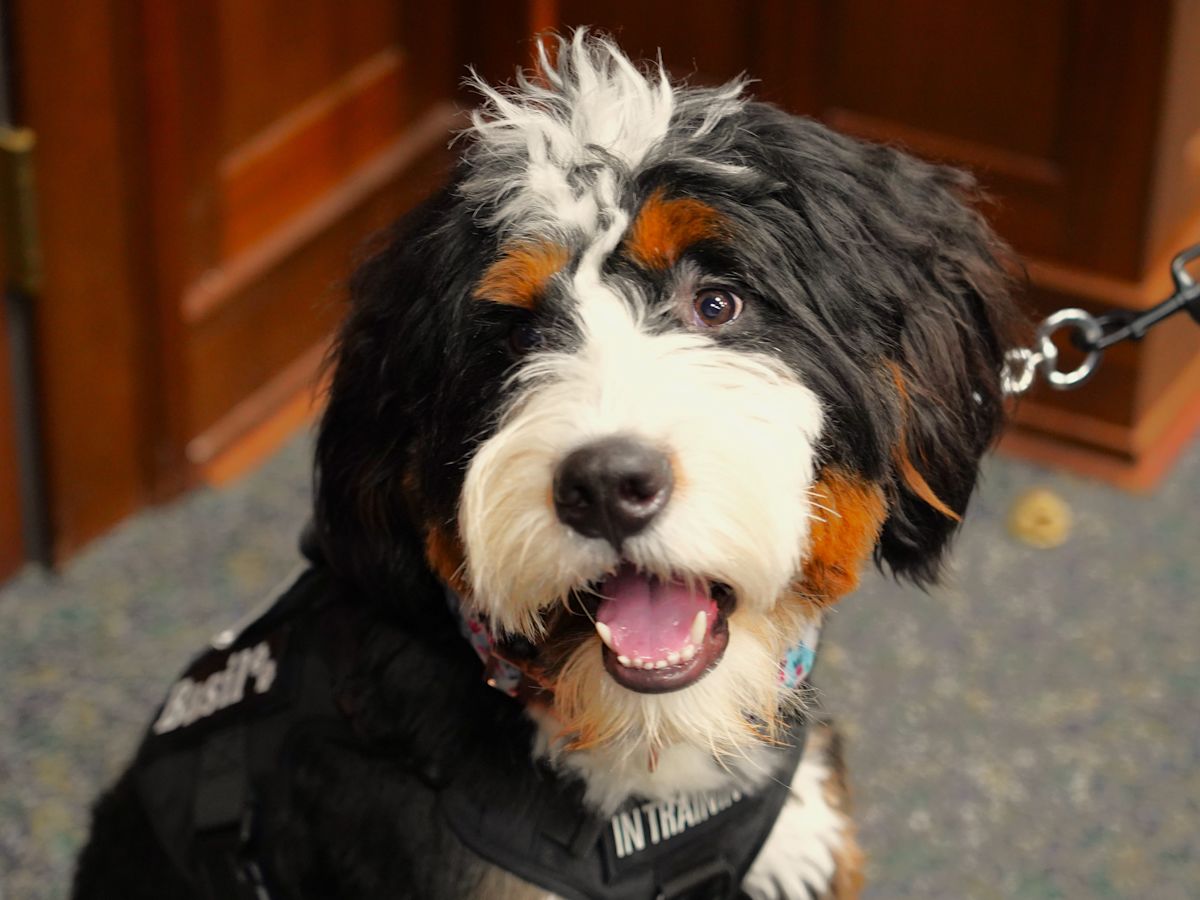
Receiving a summons for jury duty often elicits a sense of dread, but residents called to grand jury service in Hamilton County, Ohio, encounter an unexpected and comforting presence. Within the county prosecutor's facilities, a dedicated therapy dog named Basil offers support to citizens tasked with processing some of the community's most challenging criminal matters.
Easily recognized by his white fur, cheerful demeanor, and specialized vest bearing his name, Basil routinely walks the halls alongside detectives and legal staff. His role is to provide comfort not only to crime victims and their families during difficult moments, but also to grand jurors who must regularly review sensitive and traumatic case evidence.
For many participating citizens, grand jury duty presents an experience far removed from the dramatic courtroom battles often depicted on television. Rather than deciding the guilt or innocence of a defendant in an expansive courtroom setting, grand jurors perform a critical screening function inside practical administrative rooms.
Prospective jurors are selected from regional voter registration lists and driver's license records to participate in this foundational stage of the legal process. In Hamilton County, those reporting for grand jury duty also benefit from logistical conveniences, such as bypassing the lengthy security lines typical at the main county courthouse.
Grand juries are utilized in roughly half of all U.S. states to assess whether prosecutors possess sufficient evidence to bring formal criminal charges against an individual. In Ohio, these panels focus on serious felony matters, and in Hamilton County specifically, they review all felony allegations along with any misdemeanor charges connected to those felonies.
The legal standard applied during grand jury deliberations differs substantially from the beyond-a-reasonable-doubt threshold required during a trial. Under guidance from the Ohio Judicial Council, grand jurors must determine whether the evidence presented is adequately reliable and credible to show that the individual to be charged probably committed the offense, establishing the legal standard known as probable cause.
The structure of grand jury hearings is intentionally one-sided. Accused individuals and their defense lawyers do not participate, nor do they present testimony or arguments before the panel. Instead, the proceedings rely on prosecutors and law enforcement officers who present evidence, while jurors maintain the right to question officers and witnesses directly.
To issue an indictment and allow a prosecution to move forward, at least seven members of a nine-person panel must agree that the probable cause standard has been satisfied. If the required threshold is not met, the matter is dismissed through an outcome known as a "no bill" or an "ignored" case, though prosecutors may reintroduce the charges if additional evidence is uncovered later.
The operational volume handled by these panels is extensive. Jurors typically serve a two-week term, during which a single panel may evaluate 100 or more criminal cases. Across the entire county, grand juries reviewed more than 5,700 cases in 2025 alone, underscoring the relentless pace of felony intake.
Unlike less populated counties across Ohio that convene grand juries on an intermittent basis, Hamilton County maintains an uninterrupted schedule. County Prosecutor Connie Pillich noted that grand juries convene Monday through Friday, 52 weeks a year, pausing only for specific holidays, with two distinct panels of nine jurors plus alternates operating every weekday.
The rooms where these deliberations take place are situated in the Hamilton County Prosecutor's Office building on Ninth Street, located one block away from the courthouse. These spaces lack the high ceilings and open feel of formal courtrooms, occasionally becoming cramped as cases are processed back-to-back.
To improve the environment, Kate Burroughs, who began serving as Chief of Grand Juries and Intake in January 2025, took steps to refresh the facilities. Burroughs and her daughters volunteered to clean the rooms, repair well-worn seating, and add tables where none had previously existed.
Technological updates were also introduced under Burroughs' direction, including the installation of a television monitor. Prior to the addition of the display screen, presenting detectives were frequently forced to walk around the room holding up their personal mobile phones so jurors could view video footage and photographic exhibits.
The wear and tear of decades of continuous service remains evident within the physical space, where wood-paneled walls bear prominent marks caused by chair backs rubbing against them day after day. It is within these utilitarian quarters that grand juries execute their vital gatekeeping responsibilities for the local justice system.
To prepare jurors for their duties, the first day of service includes an orientation covering fundamental legal definitions and statutory concepts. Jurors receive instruction on the precise legal meanings of terms such as acting knowingly or recklessly, what constitutes legal possession, and current state firearms statutes, all while working through a lighter docket to find their footing.
As Prosecutor Pillich explained, grand jury proceedings are conducted without courtroom theatrics. The largest portion of the daily docket consists of drug trafficking and possession cases, requiring jurors to maintain a methodical focus as they weigh evidence, supported throughout the process by Basil's calming presence.





(0)