
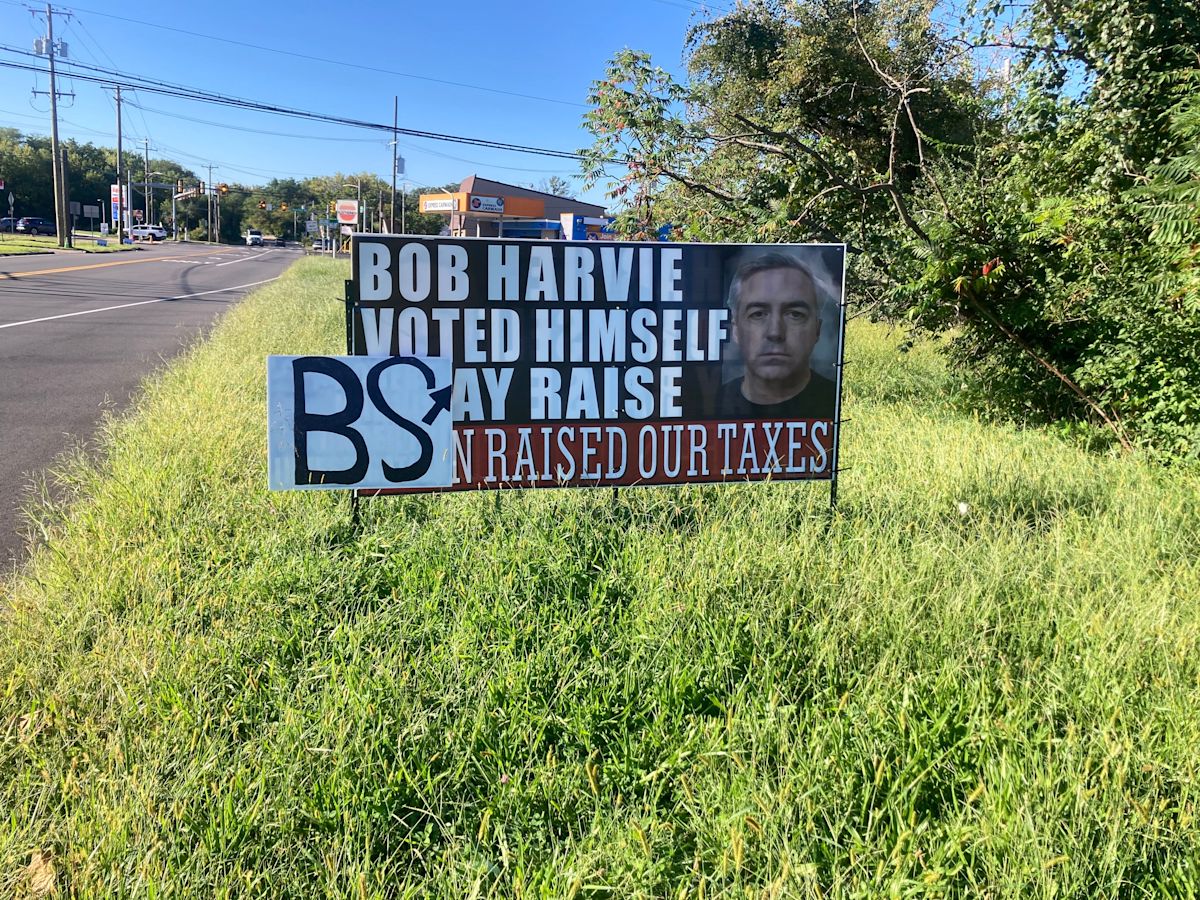
Middletown Township is preparing to implement major revisions to its local sign regulations, introducing strict uniform guidelines and potential fines reaching $500 per day for violations. Township supervisors recently gave unanimous approval to advertise the proposed ordinance, taking a decisive step toward transforming how temporary displays of all types are managed across the community.
The regulatory overhaul is designed to align Middletown’s local codes with a significant federal judicial precedent. A May 2024 ruling issued by the U.S. Third District Court mandated that municipal governments throughout Pennsylvania must treat every temporary public sign in an entirely identical manner, eliminating legal distinctions based on the content or message displayed on the sign.
That federal court determination arose from a legal challenge involving Camp Hill Borough, where municipal officials had established rules that favored commercial advertisements and "for sale" notices over political messaging and personal political commentary. The court found that Camp Hill had constructed what was described as a "crazy quilt" of regulations, which unconstitutionally infringed upon First Amendment free speech rights by limiting homeowners to only two personal expression signs while allowing other types of messaging to remain unaddressed.
In order to steer clear of similar constitutional challenges, Middletown's newly drafted framework applies an even-handed standard to every classification of temporary signage. Under this universal policy, notices advertising youth baseball registrations, power-washing services, seasonal holiday light installation businesses, and real estate offerings will now be subject to the exact same administrative scrutiny.
Despite the across-the-board application of the rules, political signage is anticipated to experience some of the most notable adjustments during election seasons. According to the provisions of the proposed ordinance, political campaign signs will no longer be permitted to appear on properties more than 30 days ahead of an election. Furthermore, property owners and campaign organizers will be required to take down all such materials within 10 days following the conclusion of voting.
The ordinance also institutes an outright prohibition against positioning any temporary signs within township-controlled rights-of-way, which commonly encompass the grassy verges and borders adjacent to heavily traveled roadways. Regardless of whether an organization is publicizing a local community gathering, a commercial enterprise is promoting services, or a candidate is campaigning for public office, no temporary signs of any kind will be permitted in these public zones.
Similar restrictions governing state-controlled rights-of-way have technically been in effect for years under Pennsylvania Department of Transportation guidelines—affecting major local thoroughfares like Bristol-Oxford Valley Road in Levittown. However, those state-level prohibitions have historically seen very limited enforcement, leading to a recurring accumulation of promotional and political signs alongside area highways.
Addressing the practicalities of maintaining compliance across the municipality, Township Solicitor Jim Esposito highlighted the logistical challenges facing local government. With roughly 50,000 residents, Middletown ranks among the largest municipalities in Bucks County, making it impractical for the local government to dispatch dedicated roving patrol units solely tasked with identifying non-compliant signage along public roads.
Rather than establishing dedicated sign inspection patrols, the township intends to integrate enforcement into routine municipal maintenance. Esposito stated that township road crews will actively collect and remove unauthorized signs from local rights-of-way whenever they encounter them while performing their standard everyday duties throughout the community.
In addition to opportunistic removals by road maintenance teams, township officials plan to rely heavily on a complaint-driven framework. Whenever members of the public report improper signage situated within municipal boundaries or public rights-of-way, township staff will investigate and take appropriate steps to address the identified infractions.
While the financial penalty for violating the ordinance can reach $500 per day for each individual infraction, local officials intend to exercise discretion when dealing with initial occurrences. Esposito explained that the township prefers to extend grace to first-time offenders, giving them the chance to correct the issue before advancing the matter to formal legal proceedings before district justices.
Nevertheless, individuals and businesses that repeatedly disregard the local guidelines can expect to face the full force of the law. Esposito emphasized that when repeat offenders are brought before a district justice after already receiving warnings to remove unlawful displays, the township will seek the imposition of the authorized financial penalties.
On private properties, such as residential front lawns, the township expects to apply a lighter regulatory touch for items like real estate "for sale" notices or personal opinion signs, particularly when no neighborhood complaints have been submitted. Even so, property owners will not have unlimited freedom regarding the physical dimensions of their displays.
Esposito clarified that all private property signage must strictly conform to uniform size standards established in the ordinance. Under the measure, no single temporary sign may exceed a surface area of 12 square feet, and the combined area of all temporary signs erected on an individual property cannot surpass a cumulative maximum of 24 square feet.
Through these sweeping adjustments, Middletown Township aims to establish a transparent, legally sound regulatory system that respects constitutional protections while curbing visual clutter along municipal corridors. By standardizing time, place, and size rules across all temporary signs, local officials hope to resolve past legal pitfalls and maintain order throughout the township's public spaces.







(0)