
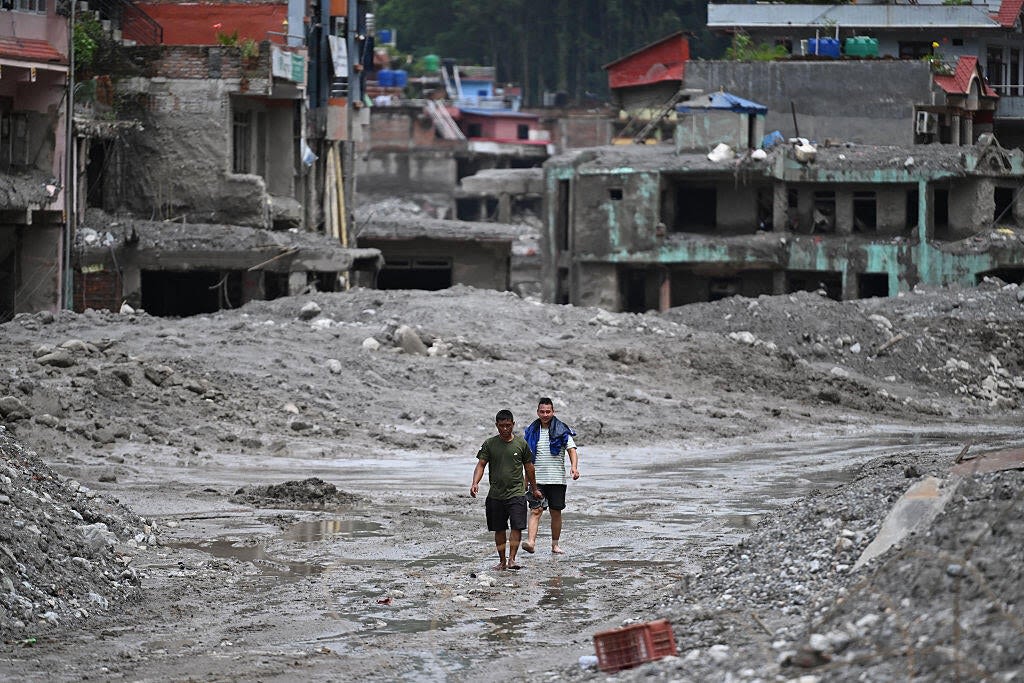
KATHMANDU, Nepal — The Nepalese government has issued an urgent warning for fresh flooding in the wake of the catastrophic floods that have already left over 900 dead and thousands missing. The disaster agency reported that the death toll has reached 903, with another 4,247 people reported missing, while Chinese authorities have confirmed 16 deaths and 546 missing on their side of the border.
The latest warning came after water levels in the Bhotekoshi River surged, prompting authorities to send alerts to residents' phones. Chinese authorities informed their Nepalese counterparts of increased water flow upstream, according to Dharam Raj Uprety, chief executive of Nepal's National Disaster Risk Reduction and Management Authority.
Survivors in the flood-affected districts are grappling with the relentless threat of further flooding, which has already caused widespread destruction. In the flood-hit villages, residents are struggling to make sense of the constant alarms they've received since the initial floods. "Sometimes they say a flood is coming, then we have to run again to higher ground, even at night. There is also rain," said Govind Shreshta, a resident. "It's really difficult for me. I have a 72-year-old father and 70-year-old mom. I must carry them and I am exhausted. It's going on like this for those who are still alive."
In Dhading, one of the worst-hit regions in Nepal, some residents have begun returning to their ruined homes to see what can be salvaged. They sit in homes with walls washed away by the floods, shoveling sludge-like mud and rubble off balconies or window frames. Others scan the ground for items they can pick out of the mud and rinse off. "Everything is finished. Nothing is left. Not even our home," said Sharmila Tamang, a Dhading resident who was trying to salvage items from her home.
The floodwaters have also caused significant damage to infrastructure, including a key power plant that serves over 20,000 people across four districts. Workers began inspecting the facilities on Sunday to survey the destruction. The plant's closure has compounded the challenges faced by the flood-affected communities, who are already dealing with the loss of homes, livelihoods, and loved ones.
The U.S. State Department has confirmed that there are currently 85 Americans unaccounted for in Nepal, with nine having been safely evacuated. U.S. State Department spokesperson Tommy Pigott said on Sunday that the department is coordinating with the Nepalese government to provide assistance to those in need. "Right now we're in communication with them directly to assess those needs. We have a disaster area response advisor actually on the ground right now, in communication to see how best we can offer assistance," Pigott said.
The missing also include hundreds of people from over a dozen countries who were in the region to work, visit the mountains, or make a pilgrimage to a sacred peak. On Sunday, Chinese state media said 261 foreigners were missing in Tibet, including over a hundred Nepalis and others from around the world.
The floods began after a glacial collapse high in the Himalayan region, which scientists say was caused by a magnitude 5.2 rockfall. The rocks and melted water then swelled the rivers in the valleys below, causing a torrent of water that swept buildings, bridges, and earth downstream in Tibet and Nepal. Nepal's foreign minister has called for a global response to climate change, saying the country is bearing a disproportionate share of its impact.
As the floodwaters recede, the Nepalese government and international aid organizations are working to provide relief to the affected communities. The situation remains critical, with the threat of further flooding and the need for long-term recovery efforts.





(0)