
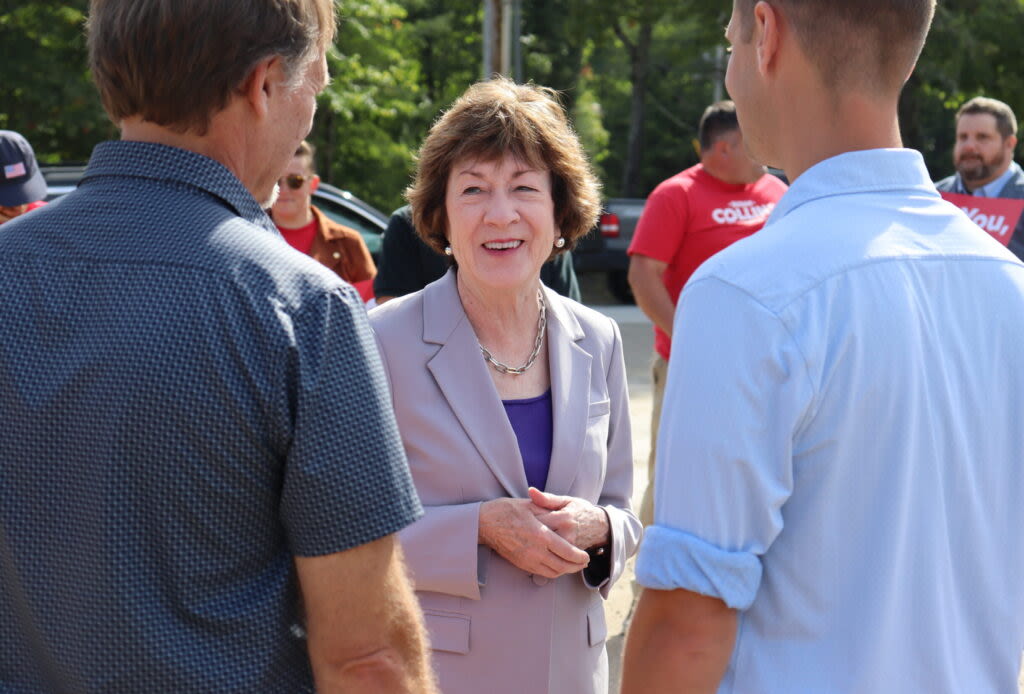
Facing a challenging political landscape, veteran Republican Sen. Susan Collins of Maine is once again leaning into a familiar campaign playbook that prioritizes localized constituent service and community investment over national ideological warfare. As she prepares for the upcoming Nov. 3 election, the five-term lawmaker is focusing heavily on small, direct voter interactions to highlight the tangible federal support she has delivered to her home state throughout her nearly three decades in office.
That strategy was on full display during a recent campaign stop in Naples, where Collins arrived on a bus bearing the slogan "Susan Collins Our Senator." The event brought the incumbent to P&K Sand and Gravel, a local family-owned enterprise spanning multiple generations. Surrounded by community residents, local business leaders, and supporters carrying campaign signs, Collins spent time conversing individually with attendees about their businesses and personal ties.
During the gathering, Collins pointed to her own personal background in small enterprise to express affinity for the local operators in attendance. She highlighted the critical role such enterprises play in sustaining the state's economic foundation, characterizing family-run businesses as the true heart and soul of Maine communities.
These intimate, low-key gatherings serve as the cornerstone of Collins' effort to secure a sixth term in the United States Senate. Throughout her visits to schools, civic organizations, and local commercial establishments across Maine, Collins routinely emphasizes the federal appropriations she has secured. In several instances, she underscores her work to protect or reclaim critical funding streams from the administration of President Donald Trump.
Her emphasis on seniority and legislative effectiveness continues to resonate with a segment of voters that extends beyond typical party lines. Among the supporters at the Naples event was Kevin Rogers, a registered Democrat who voiced unwavering backing for the Republican senator. Rogers noted that longevity in Washington provides the institutional standing required to achieve meaningful legislative outcomes for local constituents.
The Naples stop also served as the backdrop for a formal political endorsement, as Corey Mitchell, a co-owner of P&K Sand and Gravel, announced the backing of the National Federation of Independent Business. Standing before heavy equipment adorned with campaign banners, Mitchell praised Collins for maintaining a pragmatic approach in Washington. He characterized her as a lawmaker dedicated to problem-solving and cross-party cooperation rather than partisan grandstanding.
Local business leaders at the event pointed to specific legislative achievements, particularly Collins' authorship of the Paycheck Protection Program during the 2020 COVID-19 pandemic. Colleen Foster, another co-owner of the quarry business, stated that the fully forgiven federal loan prevented their operation from having to lay off roughly half of its workforce during a period of acute economic uncertainty.
Beyond high-profile federal grant programs, attendees frequently cited Collins' direct constituent intervention as a key reason for their continued loyalty. Foster highlighted the senator's assistance in addressing regulatory concerns regarding quarry inspections on their property, underscoring how routine casework reinforces Collins' standing among local business owners.
However, Collins faces a determined challenge from Democrat Troy Jackson, a logger from Allagash and former president of the Maine Senate. Jackson's campaign contends that Collins' influence as chair of the powerful Senate Appropriations Committee cannot overshadow what he describes as a voting record that aligns heavily with the Trump administration to the financial detriment of Maine residents.
The Democratic challenger has argued that despite the targeted funding Collins brings home, her consistent legislative backing of Trump administration priorities has inflicted millions of dollars in costs on the state. Jackson's campaign seeks to convince voters that the veteran lawmaker's national voting pattern outweighs the localized benefits she routinely touts on the campaign trail.
In mounting his challenge, Jackson must contend with Collins' significant campaign fundraising advantage and decades-long name recognition. Having entered the general election contest following the departure of former Democratic nominee Graham Platner earlier in the cycle, Jackson has relied on an intensive grassroots field operation to mobilize voters across Maine on a condensed timeline.
For her part, Collins has refrained from altering her fundamental approach in the final stretch before the election. Rather than introducing broad new platform proposals or debating overarching national controversies, her campaign remains centered on demonstrating what she has directly accomplished for specific towns, while simultaneously maintaining political distance from Trump.
The demands of the campaign come as Collins faces pressing responsibilities in Washington, D.C. With just 16 days remaining to negotiate federal spending and avert a potential government shutdown, her leadership atop the Senate Appropriations Committee is under close scrutiny amid unfinished legislative business.
These legislative deadlines unfold within the broader political environment of Trump's second presidential term. Historically, the political party controlling the White House faces substantial headwinds during midterm election cycles, adding another layer of complexity to Collins' re-election bid.
As the race moves toward November, the contest presents Maine voters with a clear contrast between Jackson's grassroots push against the administration's policies and Collins' reliance on legislative seniority, federal appropriations, and deep-seated constituent casework.


(0)