
Artificial intelligence is rapidly transforming the terrain of modern political campaigning in Texas, presenting voters with increasingly convincing fabricated media as the 2026 midterm elections enter their final seven weeks. What was once the domain of conventional attack ads has evolved into a digital battleground populated by high-tech fabrications, testing the electorate's ability to separate genuine campaign moments from digitally engineered illusions.
Political caricature and parody have been integral components of American campaigns since the founding era of powdered wigs and early editorial cartoonists. In those early decades of the republic, satirical sketches were easily recognized as artistic exaggerations rather than depictions of actual events, with no one confusing an illustrator's ink drawing for historical reality long before the inventions of photography and modern photo manipulation software.
Fast-forward roughly two and a half centuries, and digital tools have dramatically amplified the capacity to deceive or satirize the voting public. Today, the technology required to manufacture synthetic video—commonly referred to in political and technology circles as "deepfakes"—is widely accessible to virtually anyone with moderate technical proficiency and access to authentic photographic source material, allowing rapid and inexpensive video creation.
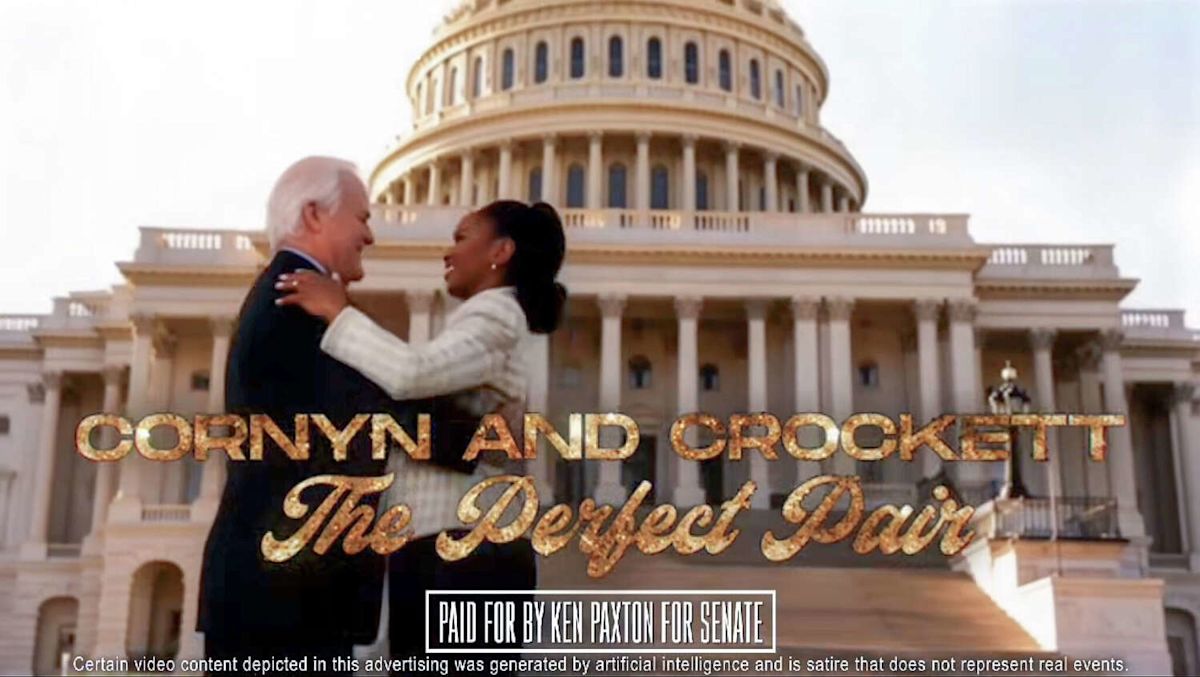
The proliferation of these tools was vividly demonstrated during the recent contentious Republican primary for the U.S. Senate in Texas. In that contest, Texas Attorney General Ken Paxton launched a high-profile deepfake advertisement targeting incumbent Sen. John Cornyn, creating a fabricated scene that showed Cornyn smiling and dancing cheek to cheek with Democratic U.S. Rep. Jasmine Crockett.
The synthetic video produced by Paxton's campaign was carefully constructed to influence conservative primary voters by integrating authentic clips alongside the computer-generated imagery. In the real footage spliced into the ad, Crockett was shown publicly acknowledging that she and Cornyn had previously collaborated on occasion to help pass bipartisan measures through Congress.
Cornyn quickly delivered a sharp counterpunch with an AI-generated production of his own. The incumbent senator's campaign circulated a video depicting Paxton riding along in a 1960s-era convertible, accompanied by a cover version of the B-52s' popular song "Love Shack" playing throughout the background of the satirical clip.
The purpose of Cornyn's digital retaliation was unmistakable: to remind Republican primary voters of Paxton's past personal scandals. The ad made direct visual references to allegations of extramarital affairs involving the state attorney general, controversies that had previously led his wife to initiate divorce proceedings against him.
Whether these sophisticated digital maneuvers fundamentally altered voter decisions remains open to question. Cornyn captured the most votes in the initial March primary balloting but was unable to secure a wide enough margin to avoid a runoff contest. When the two candidates faced off again in the runoff, Paxton secured the Republican nomination in a decisive landslide.
Rather than abandoning the tactic following the primary, Paxton has continued to employ synthetic media as the campaign transitions toward the general election. Last week, the attorney general turned his digital sights on his newly minted Democratic opponent, James Talarico, who secured his party's nomination after defeating Crockett without needing a runoff election.
Talarico, a 37-year-old seminarian, has made his personal religious faith a central theme of his campaign appearances across Texas. However, conservative Christian Republicans have repeatedly pushed back against his theological messaging, arguing that his progressive and liberal interpretation of Christian theology directly conflicts with their own traditional religious values.
Paxton's latest deepfake took direct aim at Talarico's religious positions, depicting a computer-generated likeness of the Democratic candidate that appeared roughly twenty years younger than his actual age. The fabricated footage portrayed Talarico editing passages of the Bible to claim that Jesus was a "radical feminist" and that God originally created six distinct biological sexes.
The synthetic advertisement seized upon previous controversial statements made by Talarico regarding gender identity. The Democratic candidate had previously walked back his earlier remarks about six genders, publicly clarifying that he had spoken clumsily in an attempt to convey a broader philosophical concept during the original discussion.
The aggressive use of synthetic videos in political campaigns touches on longstanding constitutional principles regarding political expression. Drawing parallels to early American political attacks—such as historic cartoons showing figures like Thomas Jefferson burning the Constitution—modern political parody remains deeply rooted in First Amendment protections safeguarding free speech and press freedoms.
State lawmakers in Texas attempted to establish boundaries around deceptive digital campaign tactics several years ago. In 2019, the Texas Legislature approved a statute that strictly prohibits the publication and dissemination of deceptive deepfake videos within the final 30-day window preceding an election, an effort led by Republican state Sen. Bryan Hughes of Mineola to balance free speech protections against campaign deception.
Nevertheless, existing legal safeguards have proven limited in scope. The 2019 Texas statute does not apply to federal contests, leaving U.S. Senate candidates exempt from state-level prohibitions and ensuring that voters will continue to encounter AI-manipulated campaign imagery as the midterm election approaches its conclusion.





(0)