
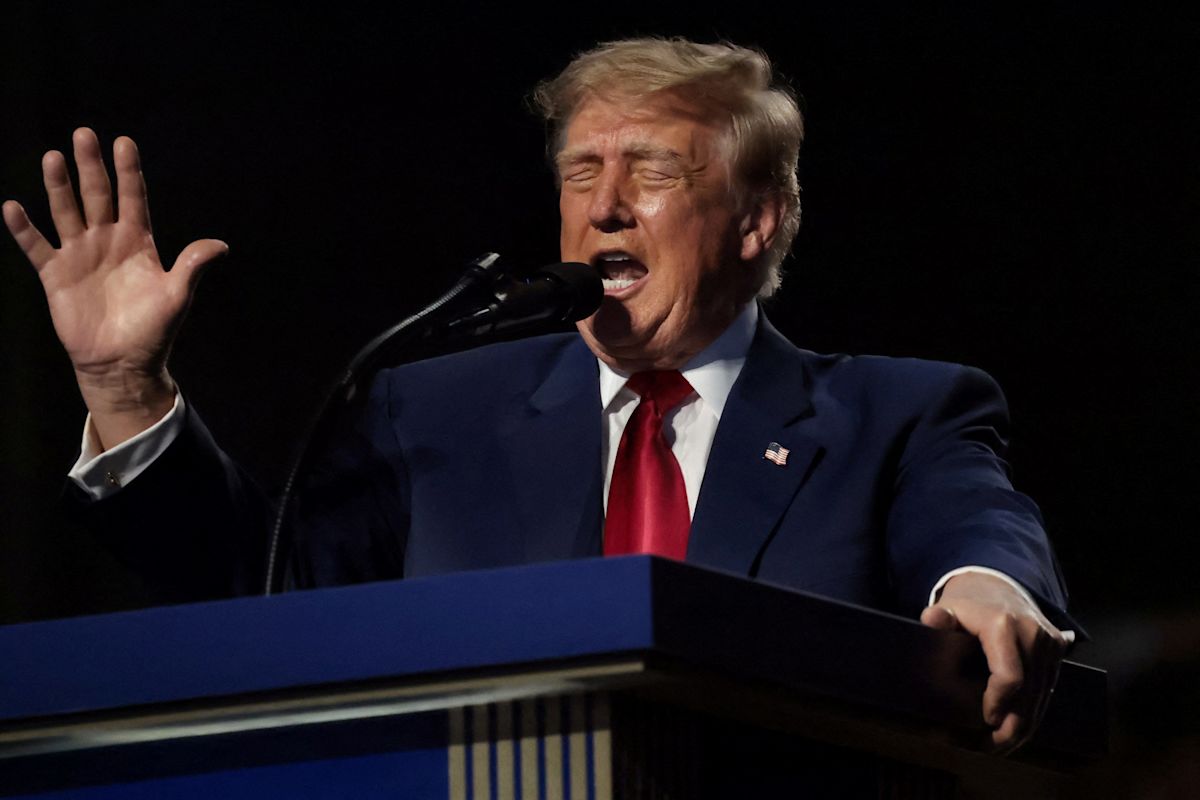
President Donald Trump has ignited a fresh political and fiscal debate on the campaign trail after pledging to distribute a substantial $5,000 dividend payment to every American adult. The ambitious financial promise, unveiled during a campaign appearance in Dallas on September 9, comes with a direct partisan condition attached for the electorate.
According to the president's announcement, the massive direct payments are entirely contingent upon the Republican Party securing full legislative control of Capitol Hill by winning majorities in both the House of Representatives and the Senate in the upcoming midterm elections scheduled for November 3.
Following the Dallas speech, the White House issued an official press release elaborating on how the administration intends to back the proposed checks. The administration asserted that the money would be drawn directly from widespread economic vigor, pointing specifically to the unleashing of trillions of dollars in new private capital investment alongside an aggressive, unprecedented crackdown on wasteful government spending.
Despite the administration's optimistic economic rationale, fiscal analysts and policy experts have expressed profound skepticism regarding the feasibility of the plan. Projections indicate that delivering a $5,000 check to every adult in the country would impose an extraordinary financial burden on the federal government, requiring an estimated outlay of $1.2 trillion.
To put the staggering scale of the initiative into perspective, fiscal watchdogs have highlighted historical comparisons. The Committee for a Responsible Federal Budget pointed out that the $1.2 trillion price tag would surpass the combined expenditure of all three rounds of emergency stimulus payments distributed during the COVID-19 pandemic.
Furthermore, budget analyses show that the cost of these proposed dividends would completely eclipse the projected annual costs of the president's signature legislative achievement, known as the "One Big Beautiful Bill" Act, over the coming year. The total outlay would also be 50 percent higher than the entire primary deficit currently projected by forecasters for the fiscal year 2027.
Economists and budget specialists warn that injecting such a colossal volume of capital into the economy without reliable offsets could carry severe macroeconomic fallout. Beyond significantly swelling the federal debt, such a massive wave of deficit-funded disbursements could risk triggering renewed waves of inflation.
Even in the scenario that Republicans manage to capture both congressional chambers in November, transforming the campaign pledge into law faces a complex legislative pathway. Any direct disbursement program of this magnitude requires explicit statutory authorization and funding from Congress, a procedural reality that typically entails months of contentious legislative maneuvering.
Beyond the halls of Congress, the initiative could also encounter significant legal barriers. Policy proposals of this nature carry the potential to trigger legal challenges that might ultimately find their way to the Supreme Court, echoing the constitutional obstacles that previously hindered past administration payment schemes.
This is far from the first time that the president has pledged direct payouts to the public that ultimately failed to reach fruition due to procedural or legal roadblocks. In early 2025, Trump floated the idea of delivering a separate $5,000 stimulus check, suggesting that the funding would be recouped from vast bureaucratic savings generated by the Elon Musk-led Department of Government Efficiency.
However, those earlier checks never materialized for the public. The much-publicized Department of Government Efficiency, commonly known as DOGE, subsequently ceased operations and was shut down earlier in the year without yielding the promised nationwide disbursements.
A similar dynamic unfolded in November 2025, when Trump promised Americans a $2,000 relief payment aimed at mitigating the financial strains associated with his expansive trade agenda. The proposed stimulus was meant to be funded through revenue collected from steep tariffs imposed across all foreign trading partners; however, those checks evaporated after the Supreme Court issued a landmark ruling declaring the tariffs unconstitutional.
Nevertheless, supporters note that the administration has managed to successfully implement certain targeted cash distributions. In December 2025, every member of the U.S. military received a special $1,776 "Warrior Dividend" bonus payment championed by the president.
While Trump initially maintained that the military checks were being underwritten by foreign tariff revenues, the actual money had to be redirected by Congress. The legislative branch funded the payments by tapping appropriated military housing resources included in the comprehensive "One Big Beautiful Bill" legislation.
More recently, the administration established the "Trump Accounts" initiative, a dedicated investment program aimed at young Americans. The program deposits $1,000 directly into savings accounts established for children born between 2025 and 2028, with the president reporting as of July 6 that roughly six million children have been enrolled in the account system.
While these past programs demonstrate that targeted payouts are technically achievable under specific frameworks, the proposed $5,000 universal adult dividend represents a dramatically larger undertaking. With widespread bipartisan skepticism, massive fiscal liabilities, and daunting procedural hurdles, the promise of a multi-thousand-dollar windfall remains an uncertain prospect for the American electorate ahead of the midterms.


(0)