
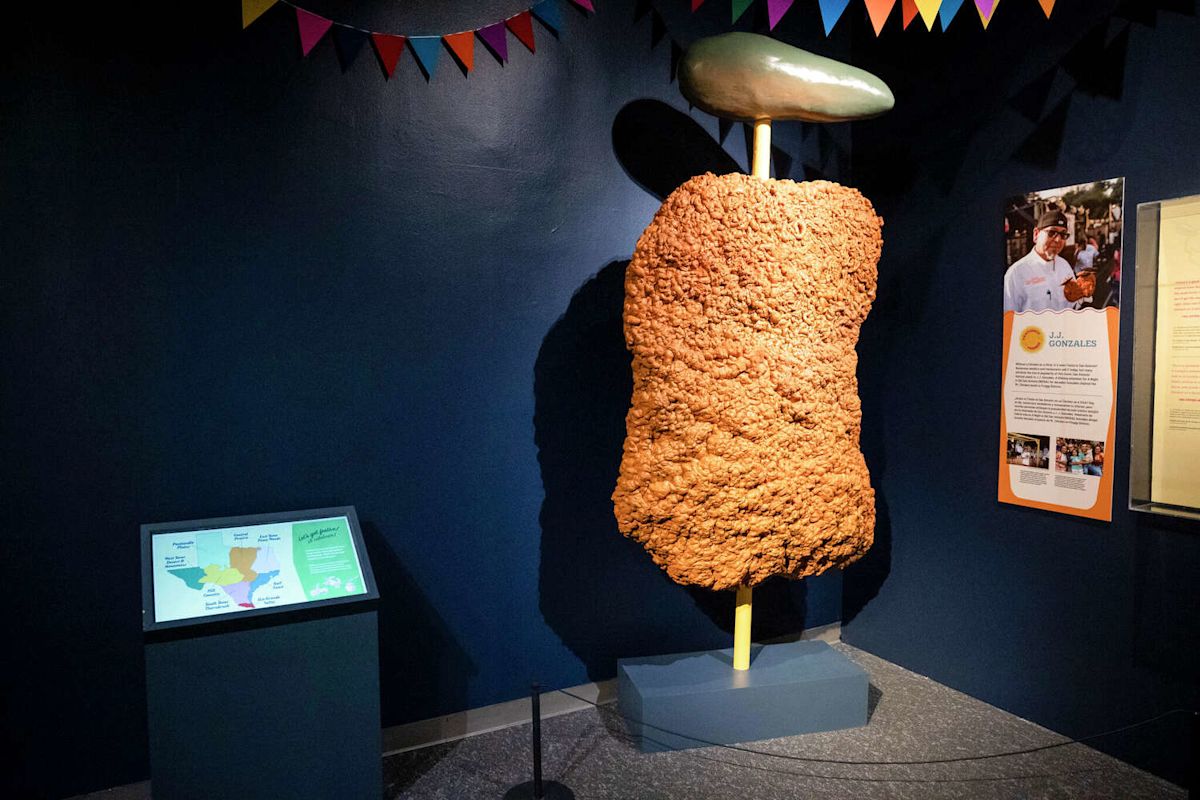
A towering culinary sculpture and a deep dive into Lone Star culinary culture have taken center stage in San Antonio as the Witte Museum marks its centennial milestone. The institution's latest major presentation, titled "Gather 'Round the Table: Texas Food Traditions," opened to the public with a comprehensive exploration of the foods, customs, and heritage that define the state. The wide-ranging exhibition is scheduled to remain on view through February 7, 2027.
Conceived and designed entirely in-house, the exhibition serves as a centerpiece for the museum's 100th anniversary. It highlights both the rich historical holdings in the Witte's permanent collection and the creative craft of its staff members, who brought iconic regional delicacies to life across multiple thematic sections.
Among the most visually striking highlights in the galleries is a colossal, 10-foot-tall sculpture of a festival-style chicken on a stick. Positioned on a bright yellow skewer and crowned with a plump jalapeño, the supersized treat features a realistic, thick golden coating that looks appetizing enough to serve a gathering, despite being entirely artificial.
Marcos Medellin, the director of exhibitions at the Witte Museum, spearheaded the construction of the centerpiece using everyday workshop materials. Medellin revealed that the towering faux snack was fashioned from shop scrap wood, chicken wire, insulation foam, and standard PVC piping, demonstrating the creative ingenuity involved in fabricating the museum's custom displays.
Museum leadership has emphasized that the food-focused exhibition captures the core identity of the institution as it enters its second century of operation. Michelle Everidge, president and chief executive officer of the Witte Museum, praised the installation as a demonstration of the staff's capabilities, describing the large-scale, artifact-rich project as the organization at its absolute best and an ideal centennial tribute.
The oversized chicken on a stick anchors a gallery space specifically devoted to Texas festivals and community celebrations. Curators recognized early in the planning process that certain regional staples were non-negotiable when representing local food culture.
Nalleli Guillen, the museum's vice president of interpretation and curator of history, noted that festival food traditions demanded the inclusion of the beloved snack. According to Guillen, colleagues made it clear during initial development that leaving out the skewer-mounted specialty would be an unforgivable oversight for an exhibition anchored in San Antonio's culinary landscape.
Beyond celebration fare, the exhibition invites visitors to explore the historical roots of what Texans prepare in their kitchens and the reasons behind those traditions. The presentation blends historical insight with engaging discussions of famous local food rivalries, tackling long-standing kitchen debates such as flour versus corn tortillas and salsa versus guacamole.
Complementing the contemporary and playful components are significant historical artifacts that trace the early roots of the region's agricultural and natural history. One prominent example on display is a vintage shadow box containing an extensive assortment of Texas pecans.
While the nut is a staple of Southern desserts, the exhibit illuminates the vast biodiversity of the crop, noting that more than 1,000 varieties of pecans exist. The featured shadow box, dating back to the early 1900s, was assembled by naturalist H.P. Attwater, who systematically gathered and categorized different specimens.
The historical wooden display contains 50 distinct pecan varieties arranged neatly in groups of three. Typewritten labels from the period identify varieties with descriptive names, including slender May Russells, robust sweetmeats, and delicate-looking Mexican Papershells, offering visitors a glimpse into early botanical documentation.
Beyond representing the agricultural heritage behind pecan pie, the shadow box holds deep institutional significance for the museum itself. The artifact belongs to the Attwater Collection of Natural History, which served as the Witte's very first major institutional purchase a century ago.
Ellen Schulz Quillin, a botanist and schoolteacher who founded the museum, acquired the Attwater collection for $5,000. A substantial portion of the necessary funding was accumulated through grass-roots efforts, with Quillin's students collecting nickels and dimes to help establish the city's museum collection.
Items from that original Attwater acquisition were among the first objects presented to the public when the institution formally opened its doors as the Witte Memorial Museum on October 8, 1926. The organization later simplified its name in 1984 by dropping the word "Memorial."
In addition to visual and historical elements, the exhibition incorporates interactive sensory installations to engage visitors. Among these features is an olfactory station where guests can sample the scents of eight different culinary spices that frequently appear in Texas kitchens, rounding out a multi-sensory journey through the state's storied foodways.


(0)