
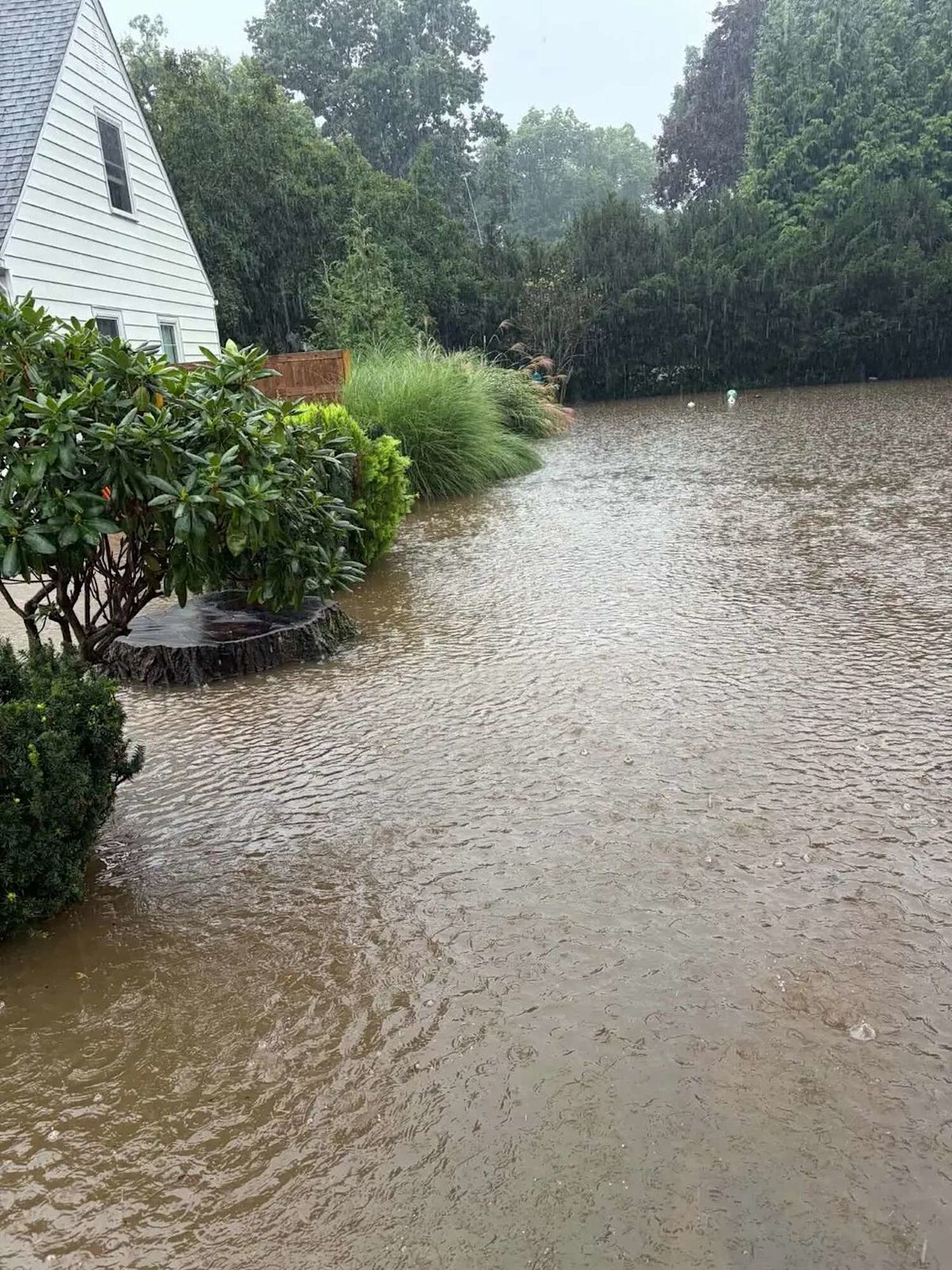
A destructive weekend deluge has reignited deep frustration among Fairfield homeowners living along the Rooster River watershed, where long-anticipated municipal flood control initiatives have faced years of procedural delays. Following a torrential downpour that inundated basements across the area, affected residents are openly criticizing local authorities for failing to implement timely protections against recurring water damage.
Among the hardest-hit neighborhood members is George Paci, who spent the days following the storm pumping out roughly seven feet of water from the basement of his Fairfield residence. The devastating incident marked his fourth major flood encounter in the past eight years, coming merely a couple of months after another weather event forced two feet of water into the lower level of his home.
The onset of the recent disaster was exceptionally swift, according to Paci. As the nearby Rooster River surged beyond its banks, runoff rapidly enveloped the surrounding property, submerging his entire yard beneath two feet of standing water. Within roughly 20 minutes of the floodwaters breaching the structure, the basement was inundated to the level of the first-floor joists, while a detached garage was overwhelmed by thick mud and water.
Despite possessing a sump pump along with two supplementary water pumps, the homeowner found the equipment entirely ineffective against the sheer volume of water. Because the surrounding soil and yard were already fully saturated, the pumps merely recycled the water back onto flooded ground. Paci and his wife were also left without electrical service, joining numerous other Connecticut utility customers who suffered storm-related outages.
The recurring flooding has taken a massive financial and physical toll on the household over the last eight years. Paci recounted that the persistent damp and water infiltration have forced him to cycle through three separate furnaces, four clothes dryers, three washing machines, and three electrical distribution panels. Furthermore, costly power tools are currently oxidizing after being submerged, with their operational status unknown until electrical service is safely restored.
With additional precipitation projected in the near-term forecast, Paci expressed exhaustion over the cleanup process, having moved salvageable basement items into his flooded yard. He noted that selling the property is largely unfeasible due to its documented vulnerability to environmental hazards, leaving homeowners feeling trapped in an ongoing crisis while waiting on municipal intervention.
Fairfield First Selectperson Christine Vitale acknowledged the unusual severity of the weekend weather event, which overwhelmed standard drainage patterns. Vitale reported that localized rainfall surpassed six inches in an exceptionally condensed timeframe, triggering basement flooding even in residences that historically remained dry during major storms. Municipal teams continue to collect damage assessment data across the affected neighborhoods.
Addressing the scale of the storm, Fairfield Public Works Director Frank Petise explained that the torrential rainfall matched the benchmark of a 100-year storm event, an environmental threshold signifying a 1% statistical likelihood of taking place within any single calendar year. Petise emphasized that intense, high-impact weather patterns are becoming noticeably more frequent across the region.
Emergency communication protocols also surfaced as a point of discussion among impacted residents following the storm. Vitale clarified that town administration relies on the National Weather Service to transmit automatic flash flood warnings to all active mobile devices within the designated geographic perimeter, while municipal staff concentrates on publishing hyper-local developments and guidance through Fairfield’s official social media channels.
Addressing the broader timeline of structural solutions, Petise noted that mitigating flood hazards along the Rooster River corridor was formally designated as a local priority between eight and ten years ago. Following notable flooding in 2018, the town deployed existing resources to initiate preliminary engineering designs across the watershed, though administrative hurdles slowed progress.
Petise explained that complex permitting requirements through regulatory bodies—specifically the U.S. Army Corps of Engineers and the Connecticut Department of Energy and Environmental Protection—contributed significantly to the extended project timeline. These interagency reviews were necessary steps before heavy construction could legally commence on major retention features.
To date, the town has assembled an $8.2 million funding pool dedicated to comprehensive Rooster River flood mitigation. The capital package includes $4.5 million in municipal bond authorizations, $2.5 million secured through state funding, a $280,000 grant from the Connecticut Department of Energy and Environmental Protection, and $750,000 in American Rescue Plan Act funding allocated by the city of Bridgeport, which owns the Fairchild Wheeler Golf Course.
Progress is expected to visibly accelerate as two primary detention basin projects—situated at the Fairchild Wheeler Golf Course and Tunxis Hill Park—complete the bidding phase. Petise confirmed that physical construction on both detention installations is slated to launch before the conclusion of the month, representing the first major earthworks of the mitigation plan.
Additional phases remain in development, including the engineering of a third detention basin that requires coordination with private property owners to secure necessary land easements. Town plans also encompass targeted dredging operations along select segments of the Rooster River to improve water conveyance during heavy discharge events.
Town officials estimate that the cumulative execution of these engineered interventions could reduce neighborhood flood levels by 30% or more upon completion. However, long-suffering residents like Paci remain wary, expressing doubt that the proposed interventions will provide sufficient protection against increasingly volatile storm systems after years of waiting for relief.


(0)