
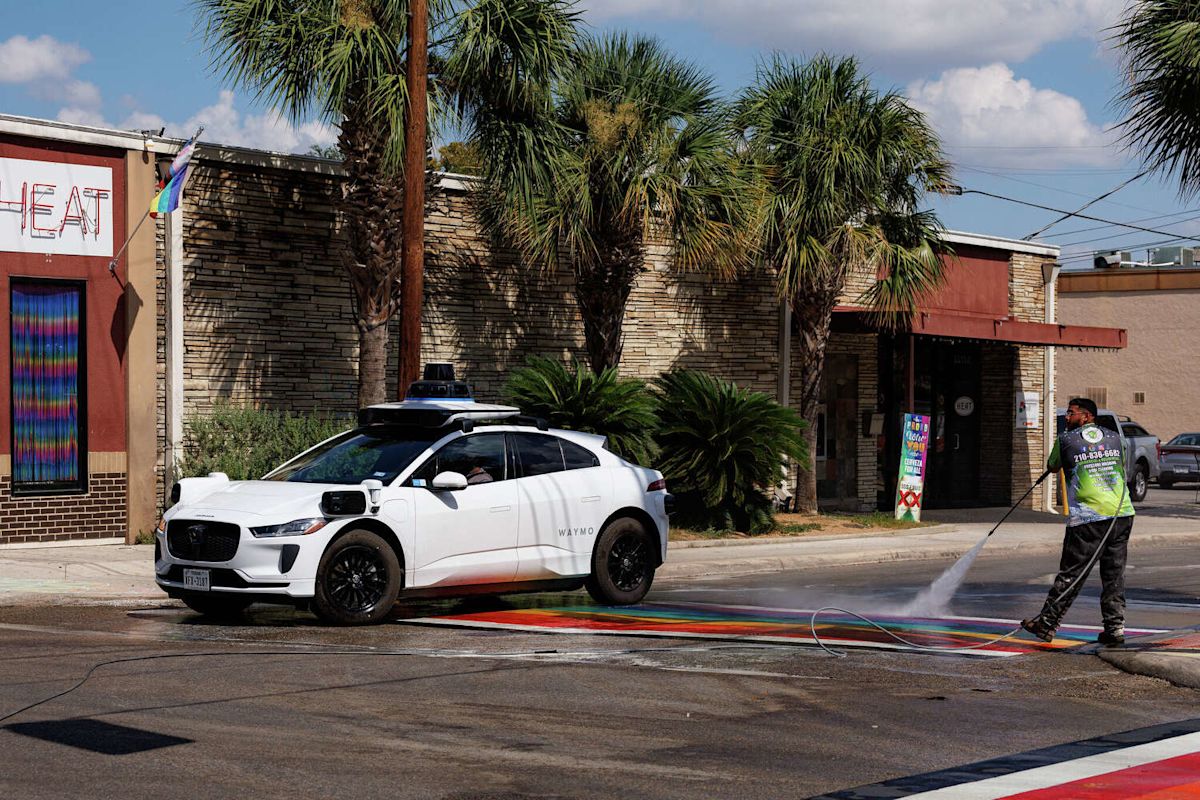
Extensive municipal law enforcement files have brought to light the broad range of operational hurdles encountered by Waymo's driverless fleet across the city of San Antonio. Documented across approximately 270 pages of police reports, the records demonstrate that the company's autonomous vehicles routinely struggled with complex real-world traffic scenarios prior to the temporary halting of local ride-hailing services.
The hundreds of pages of municipal documentation capture a wide assortment of roadway disturbances linked to the Google spinoff's self-driving fleet. While the vast majority of emergency calls were prompted by stalled robotaxis obstructing ordinary traffic flow, authorities also logged reports detailing low-speed collisions, vehicles stranded in standing storm waters, and instances of wrong-way or erratic driving. Additionally, officers recorded three separate incidents in which autonomous vehicles struck cats.
Commercial passenger operations were officially shut down throughout San Antonio in April following a high-profile incident in which a Waymo vehicle was swept away on a flooded roadway. Despite the continued suspension of commercial passenger rides, the company has formally resumed testing its sensor-equipped, autonomous Jaguar I-PACE sport utility vehicles on municipal streets under controlled conditions.
Safety statistics outlined in the public records show that the autonomous Jaguar I-PACE SUVs have not caused any human injuries while operating in self-driving mode within San Antonio. However, the technology has not been entirely free of severe incidents; a pedestrian required emergency hospitalization in April after being struck by a Waymo vehicle that was being manually steered by a human operator at the time of the crash.
A central issue highlighted throughout the police records is the sheer frequency with which the self-driving cars became immobilized. Between June 2025 and April, local dispatchers fielded at least 24 distinct calls regarding Waymo vehicles that had halted in intersections, active driving lanes, private driveways, and road shoulders, often demanding attention from municipal emergency services.
These operational disruptions stretched across the entirety of Waymo’s 60-square-mile San Antonio operational territory. Incidents were particularly concentrated along heavily traveled near-downtown and north-central transit corridors, including Basse Road, San Pedro Avenue, Interstate 35, Austin Highway, Harry Wurzbach Road, and New Braunfels Avenue.
The files detail numerous instances where unanticipated infrastructure glitches completely baffled the autonomous driving systems. On April 3, for example, two separate Waymo robotaxis stopped dead at the intersection of Burr and Wurzbach roads when an overhead traffic signal became stuck on red, forcing frustrated human drivers to maneuver around the stalled vehicles. Five days later, another Waymo was similarly immobilized at Basse Road and McCullough Avenue when malfunctioning railroad crossing gates failed to lift properly.
Other roadway obstacles presented similar navigation challenges for the fleet. During another April disturbance, two driverless vehicles were found diagonally blocking traffic at the intersection of Cloverleaf and New Braunfels avenues, though both cars departed before an officer arrived on scene. Earlier in the year, on February 3, two officers were dispatched to physically assist in clearing a disabled Waymo from an Interstate 35 frontage road lane, with an officer noting in the log that they successfully moved the vehicle out of the path of traffic.
An analysis of the 24 traffic-obstruction reports reveals a varied range of final outcomes. In 12 instances, the autonomous vehicles had already cleared the roadway or departed before officers arrived at the scene. Nine calls necessitated direct physical or dispatch intervention from police officers, emergency dispatchers, or Waymo ground support personnel. The remaining logs noted two incidents with unrecorded outcomes and one occurrence where responding authorities determined the vehicle did not present an active traffic hazard.
Public scrutiny regarding the autonomous fleet has also spilled over onto social media, occasionally generating confusion over routine field assistance. When an image surfaced online appearing to show an officer conducting a traffic stop on a Waymo near San Pedro Avenue and West Elmira Street, police spokeswoman Julyssa DeLuna clarified that the officer had merely stepped in to help safely relocate a vehicle that had already stalled on its own.
In an effort to mitigate these recurring roadway conflicts, municipal emergency agencies have sought closer coordination with the technology developer. The San Antonio Police Department confirmed that both police and fire personnel conducted joint training sessions with Waymo in late 2025, specifically designed to instruct local first responders on proper protocols for interacting with and manually overriding the autonomous vehicles during emergencies.
These local street-level friction points coincide with broader regulatory interest across Texas. Federal oversight has intensified after multiple regional incidents prompted the National Highway Traffic Safety Administration to issue formal warnings to robotaxi operators regarding the critical need to avoid obstructing emergency personnel and first responders.
At the same time, the local autonomous driving landscape is growing increasingly competitive. Even as Waymo reevaluates its service footprint following the spring flooding incident, rival autonomous operator Tesla recently secured municipal approvals to develop a dedicated robotaxi facility near the San Antonio airport.
Addressing the findings within the police records, Waymo spokesperson Nye Davidson argued that emergency dispatch logs provide an incomplete and potentially misleading view of fleet operations. In an emailed statement, Davidson stressed the necessity of distinguishing between broad police reports that merely reference a Waymo vehicle and genuine operational failures that required direct municipal assistance, rejecting the idea that all 50 recorded interactions should be classified as operational failures attributable to the company.
Ultimately, the 270 pages of documentation emphasize the continuous friction that occurs when autonomous vehicles encounter urban infrastructure originally designed for human drivers. While the records illustrate strange public interactions and showcase how on-board vehicle camera systems can potentially assist law enforcement in solving neighborhood crimes, they also underline the persistent need for human intervention whenever self-driving systems encounter irregular road conditions.




(0)